

The sector
Tourism is an important economic sector in Europe. Within the EU, there are 1.7 million enterprises classified as hotels and restaurants, employing over 9 million people and generating annual turnover of EUR 430 billion. Europe is the largest tourism region in the world, hosting 53 % of international tourist arrivals. Five European countries rank in the world's top-ten by international arrivals: France, Spain, Italy, United Kingdom and Germany. The average long-term growth rate in the European tourism sector is 2.8 %.
The tourism sector has high potential for environmental improvement. Tourists have a large environmental footprint compared with residents, travelling long distances and concentrating in destination "hotspots" where they can give rise to local environmental pressures through demand for development, water and energy, and generation of waste. Tour operators and destination managers, such as local authorities, can influence tourist behaviour and the environmental condition of destinations, for example through the provision of infrastructure and services. They also have considerable influence over small tourism enterprises. Resource consumption per guest is high in accommodation and food & drink establishments, and the eco-efficiency of such establishments varies widely, indicating high potential for improvement through dissemination of best practice. Through "choice editing", green procurement and modification of their offers, the management of all tourism enterprises can leverage a positive environmental influence over a wide sphere, and well managed tourism can generate income from natural resources in a sustainable manner.
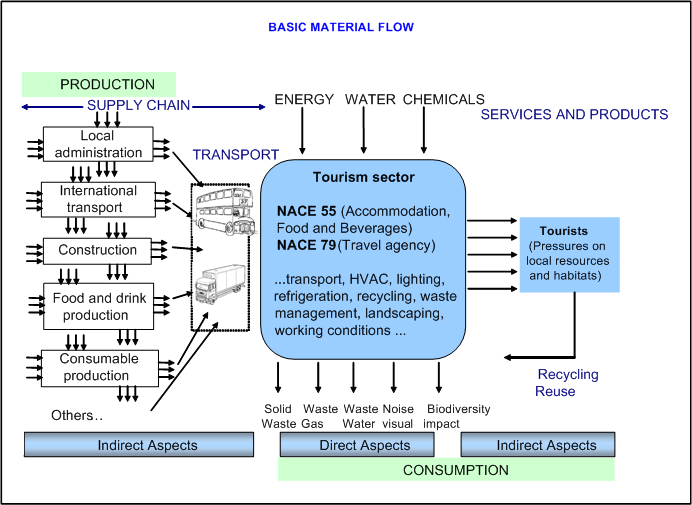
Within its work on identification of best environmental management practice and development of EMAS Sectoral Reference Documents for different sectors, the JRC developed a sectoral reference document on best environmental management practice for the tourism sector. The primary target actors are tour operators, accommodation and food & drink establishments, and destination managers, such as local authorities. The main direct and indiret environmental aspects of the sector are described in the following input/output scheme:
The Best Environmental Management Practices (BEMPs) identified are best practices at the process level, targeted at the main actors within the sector and addressing the most significant environmental aspects:
- BEMPs for destination management. These include development planning and conservation measures, and the provision of adequate services to cope with peak season tourist demands (e.g. modular, high capacity wastewater treatment plants).
- BEMPs for tour operators and travel agents. These include collaboration with destination managers to improve the environmental condition of destinations, optimisation of transport to reduce emissions, leveraging eco-efficiency improvement from accommodation suppliers, and marketing of more sustainable tours.
- BEMPs to minimise energy consumption in accommodation establishments. These include improving the thermal insulation of the building envelope, optimisation of HVAC systems, improved lighting efficiency and use of renewable energy sources.
- BEMPs to minimise water consumption in accommodation establishments. These include system monitoring and maintenance, installation of efficient fittings, optimisation of laundry processes, environmentally sound landscaping and irrigation, efficient swimming pool management and use of greywater.
- BEMPs to minimise and manage waste in accommodation establishments. These include waste minimisation through green procurement, onsite sorting and recycling and wastewater treatment.
- BEMPs for food & drink providers. These include efficient procurement and management of food, optimised waste management, efficient washing and cleaning processes and efficient cooking processes.
- BEMPs for campsites. These include environmentally friendly site management, efficient washrooms, use of renewable energy sources, and provision of waste management facilities.
For each BEMP, key environmental performance indicators (to measure the environmental performance in each area) and benchmarks of excellence (an indication of the level of environmental performance achieved by the best performers in the sector) were also identified. In addition, the work looked closely at the potential implementation of the best practices by SMEs by summarising and indexing relevant techniques.
Work plan
- Development of Background Document: January 2010 – January 2011.
- Contact with stakeholders and setting up the Technical Working Group (TWG): January 2011.
- Kick-off meeting of the TWG, Brussels, 31 March 2011.
- Development of the first draft of the best practice report for the Tourism sector, January 2011 – November 2011.
- Final Meeting of the TWG, Brussels, 24-25 November 2011.
- Final draft of the best practice report for the Tourism sector, December 2011.
- Official publication of the best practice report: September 2013.
- Adoption of the sectoral reference document: April 2016.
Current status
Based on a preparatory study carried out by Grontmij-Carl Bro and the inputs, feedback and validation received from a Technical Working Group comprising experts from the sector, the JRC produced the best practice report for the tourism sector.
On the basis of the best practice report, the European Commission produced the related EMAS sectoral reference document on best environmental management practice for the tourism sector, which was officially adopted in April 2016.
Project Team
The following people are part of the JRC EMAS SRD team:
- Paolo Canfora
- Marco Dri
- Ioannis Antonopoulos
- Pierre Gaudillat
The best way to contact the IPTS EMAS team is sending an e-mail to JRC-EMAS-SRD@ec.europa.eu
Documents
2016
2015
2013
2012
- Presentation at the event "Green Innovation in Tourism: enhancing competitiveness and reducing costs" organised by the World Tourism Organisation in the framework of Hotel Energy Solutions at World Travel Market 2012, London, 8 November 2012
- Presentation at the Smart Destination Forum, Barcelona, April 2012
2011
- Minutes of the final meeting of the technical working group
- Minutes of the kick-off meeting of the technical working group
- Tourism BEMP techniques presentation
2010